01Find it. Fix it. Close it.
This is Part II of The Creative Liability Gap series
Part I established why enterprise brands carry direct liability for IP violations in their marketing content — regardless of who produced it. The short version: the brand is always liable. This paper is the practical guide to finding where that liability lives in your organisation, auditing your current state, and closing the gap permanently.
Three numbers before we begin
Statutory damages per infringement under US copyright law — no proof of loss required
Sony Music v. Marriott International, 2024 — one brand, one enforcement campaign
Are invisible to your DAM and DRM/Rights Mgmt tools combined — right now, today
Five parts. One framework.
- 01 · Where the risk hides
- Five locations in your workflow where IP exposure accumulates.
- 02 · The audit checklist
- A framework your team can run against your current ops today.
- 03 · The creative chain
- Three diagrams mapping exactly where rights data disappears.
- 04 · How Medialake fixes it
- Resolution of each risk category inside your existing stack.
- 05 · What to do on Monday
- Five time-boxed actions. Named owners. No ambiguity.
02Five places IP risk is hiding in your workflow right now
Most enterprise marketing teams assume that if a rights violation existed in their content, someone would have caught it. The creative production chain has at least five distinct points where risk accumulates — none of which are visible to the systems most brands rely on.
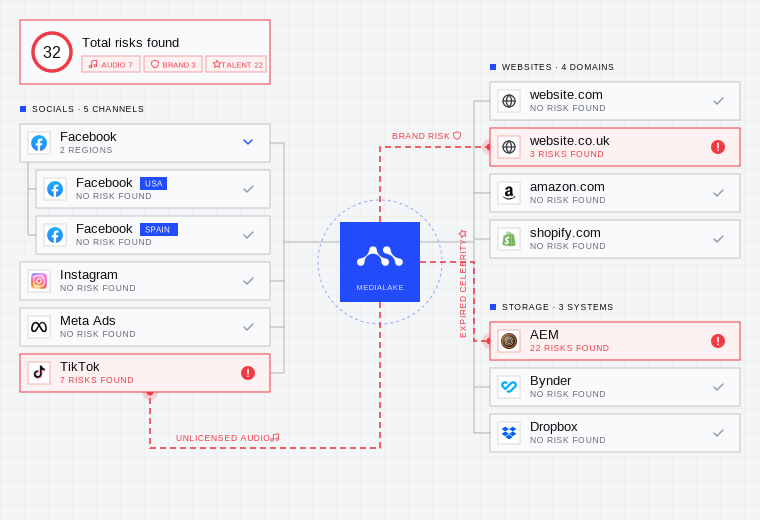
For each risk type: what it is, where it appears, and the signal that tells you it is present.
| Risk · where it appears | What it is, and the signal | Severity |
|---|---|---|
| 01 · Unlicensed musicSocial, digital video, paid advertising | Audio not sourced from a paid commercial library or documented sync licence. TikTok Sounds, Instagram Music, and YouTube Audio Library are personal-use licences only — using them on a brand account is infringement. Ask agencies to produce a music clearance certificate per video. If they cannot, the risk is live. | Critical |
| 02 · Expired rights windowsAll channels — especially always-on social | A fixed-term licence that has lapsed while the asset remains live. Common in talent, music, and stock. Risk is invisible because no system monitors expiry against live channels. Signal: can you list right now every live asset whose rights expire in the next 90 days? | High |
| 03 · Territorial overrunGlobal social, programmatic, DOOH | A licence cleared for one territory distributed globally without restrictions applied. Common in talent and music sync deals specifying named markets. Frequently introduced during reversioning. Signal: are territorial boundaries from contracts mapped to your distribution data at asset level? | High |
| 04 · Platform licence mismatchSocial — repurposed paid creative | A broadcast or paid-digital licence used on organic social. Broadcast licences routinely exclude social by name. Paid creative adapted and posted organically is one of the most common sources of this violation. Signal: does your social team know which assets are cleared for organic vs paid vs broadcast? | High |
| 05 · Untracked agency assetsAll channels — always-on and regional | Content produced by agencies, influencers, or regional teams that was never submitted to the DAM or DRM tool. No rights record exists. This is the structural source of the ~50% gap — and the category most likely to contain violations across all four risk types above. | Critical |
Key principle
If you cannot answer the signal question for any of these five categories with documented evidence, the risk is present.
03Run this against your current operation today
Complete with your Head of Marketing Operations, Legal, or Brand — ideally with input from your lead agency and DAM administrator. Approximately 30 minutes.
Do you have music clearance documentation for every video asset currently live on your brand’s social channels?
- No — or you don’t know
- Some assets documented, not all
- Yes — documented for every live asset
Can you identify right now which live assets have rights expiring in the next 90 days?
- No system or process exists
- Manual spreadsheet, not automated
- Automated alert system in place
Are territorial restrictions from talent and music licences mapped to your paid and social distribution?
- No — territorial data not tracked
- Known for major campaigns only
- Mapped and enforced across all channels
Does your social team know which assets are cleared for organic vs paid vs broadcast use?
- No distinction made
- Guidance exists but inconsistently applied
- Clear process — assets tagged by usage type
Is there a complete inventory of every asset your agencies have produced in the last 24 months?
- No — agency content not centrally tracked
- Major campaigns tracked, not all output
- Full inventory with rights records in DAM
Does your DRM/Rights Mgmt tool receive data from your lead agency, social agency, and regional teams?
- No — only from DAM submissions
- Partial — one or two sources only
- All sources feed rights data automatically
Is a team member explicitly responsible for monitoring live content for rights violations continuously?
- No dedicated ownership
- Responsibility shared informally
- Named owner with automated tooling
When a campaign asset is repurposed for a new market, is the licence re-checked before activation?
- No — assumed to carry through
- Sometimes — at the team’s discretion
- Mandatory re-check in the workflow
Scoring guide: More than two red responses: material compliance gap requiring immediate action. More than four amber: structural process failure creating ongoing exposure. Full green: target state.
04Where each risk category appears in your architecture
The three diagrams below map the creative workflow from brief to live channels. They show where the five risk categories accumulate — and why your current tool stack cannot see them.
Without Medialake: where rights data disappears
Assets move left to right through three agency tracks. The critical drop-off between delivery and the DAM is where all five risk categories become invisible. Your DRM tool syncs from the DAM and inherits exactly the same gap.
Without Medialake — rights data lost in transit
Trafficking and reversioning adds more untracked variants
Assets arrive from agencies with no rights documentation
Rights tools sync from DAM. What is not in DAM is not in DRM
No system detects when music or talent rights expire
Licence for one platform not valid on another
Fig. 1 · Without Medialake: ~50% of assets cross to live channels without rights data. DAM and DRM tools both operate on partial visibility only.
With Medialake — rights data captured across all tools, all channels, continuously
Trafficking and reversioning — rights verified at every step
Every asset, every agency, rights attached at ingest
All assets enriched and pushed to DAM regardless
Medialake enriches DRM directly — every asset
Licence verified before any cross-platform use
Fig. 3 · With Medialake: every asset captured, DAM and DRM enriched to full visibility, continuous monitoring across all live channels.
The shared blind spot: what DAM and DRM see vs. what is live
Both tools see only what was formally submitted. The untracked half is where all five risk categories concentrate. Rights enforcement technology monitors all of it continuously.
DAM
~50%Formally ingested assets
- Hero films and approved assets
- Approved print and OOH
- Some paid digital (when trafficked)
DRM / Rights Mgmt
~50%Synced from DAM — same gap
- Rights records synced from DAM
- Expiry dates for ingested assets
- Contractual terms — known assets only
Not tracked anywhere
~50%Invisible to all tools
- Agency social and always-on content
- Regional and local adaptations
- Expired-licence assets still running
- Influencer and UGC republished by brand
Fig. 2 · The shared blind spot: approximately 50% of live content is untracked in any system.
The shared blind spot
Assets that bypass the DAM bypass DRM too. Enforcement sees everything. Your tools see half.
05How Medialake resolves each risk category
For each of the five risk categories: what your current stack leaves unresolved, and how Medialake closes it — without replacing your DAM, DRM tool, or agency workflows.
| Risk category | Current stack leaves open | Medialake closes it |
|---|---|---|
| 01 · Unlicensed music | No automated detection. Agencies provide no consistent clearance documentation. Platform libraries assumed to be commercial licences. | Audio fingerprinting identifies music usage across all ingested assets. Clearance certificates captured at ingest. Platform-licensed tracks flagged as non-commercial. |
| 02 · Expired rights | DAM and DRM hold expiry dates only for formally submitted assets. No system monitors live channels. Expired assets remain live indefinitely. | Tracks rights expiry across all assets — including those never submitted to the DAM. Automated alerts fire 90, 30, and 7 days before expiry. |
| 03 · Territorial overrun | Territorial restrictions in contracts not connected to distribution data. Teams have no visibility of licence geography at activation. | Territorial restrictions from contract metadata mapped to asset records. Flags out-of-territory activation before it occurs. |
| 04 · Platform mismatch | Usage type restrictions not communicated at asset level. Social teams republish paid creative without knowing the licence boundary. | Assets tagged at ingest with permitted usage types. Restrictions surfaced to trafficking and social teams at point of activation. |
| 05 · Untracked assets | ~50% of agency-produced content never reaches the DAM. DRM tools inherit the same gap. No rights record exists for this content. | Connects to agency delivery systems directly — capturing assets and rights data at source, before they reach or bypass the DAM. |
Important
Medialake does not replace your DAM, DRM tool, or agency workflows. It is the intelligence layer that sits above your existing stack — making every tool in it more complete.
06What to do on Monday
Five actions that can be initiated immediately — before any new tooling is in place.
- Day 1 · This weekCommission a music clearance audit of all video assets currently live on your brand social channels.Owner: Head of Brand or Marketing Operations. Ask every agency for clearance documentation per live video. Any asset without documentation flagged for immediate review.
- Day 2 · This weekPull a list of every live asset whose rights expiry date falls within the next 90 days.Owner: DAM Administrator or Legal. If this list cannot be generated, that is itself the finding.
- Week 1 · Within 5 daysBrief your lead and social agencies on the five risk categories in this document. Request written confirmation of their clearance process.Owner: Head of Marketing Operations.
- Week 2 · Within 10 daysMap your tool architecture against Diagram 1. Identify which delivery routes bypass your DAM and DRM tool entirely.Owner: Marketing Technology or Operations.
- Week 3 · Within 15 daysRequest a Medialake State of the World report for your brand.Owner: CMO or Head of Marketing Operations. A 60-day proof-of-concept that maps your full creative estate.
07The full picture. In 60 days. On top of your existing systems.
Every diagnostic question in Part 1, every red or amber response in the audit checklist, every gap in the fix table — Medialake answers all of them inside a single structured 60-day proof-of-concept engagement. No DAM migration. No disruption to agency workflows.
Connects to your DAM, DRM tool, agency delivery systems, paid media platforms, and social channels. Within two weeks, Medialake has a complete inventory of every asset — including the ~50% that exist outside your DAM today.
Audio fingerprinting across all video and social assets identifies unlicensed music. Rights metadata extracted, normalised, and matched against live channels. All five risk categories checked, documented, and quantified.
Every identified risk scored by severity, financial exposure, and urgency. Full compliance dashboard built across DAM, DRM tool, and all connected channels.
A structured report covering: your complete marketing asset universe; end-to-end compliance exposure mapped to the five risk categories; a prioritised action plan; and an executive summary for legal, finance, and board-level review.
What the eight checklist questions look like after 60 days with Medialake
- Do you have music clearance documentation for every live video asset?
- Answered. Audio fingerprinting identifies every track in use. Clearance certificates captured and linked to each asset at ingest.
- Can you identify every live asset whose rights expire in the next 90 days?
- Answered. Automated expiry monitoring fires alerts at 90, 30, and 7 days. Dashboard shows all upcoming expirations by channel.
- Are territorial restrictions mapped to your distribution?
- Answered. Territorial metadata from contracts mapped to asset records and checked against active distribution at activation.
- Does your social team know what each asset is cleared for?
- Answered. Usage-type tags (paid, organic, broadcast) attached to every asset and surfaced at point of activation.
- Do you have a complete inventory of all agency output for the last 24 months?
- Answered. Connects to agency delivery systems directly, capturing all output regardless of DAM submission.
- Does your DRM tool receive data from all agency and regional sources?
- Answered. Medialake enriches the DRM tool directly from every source. Coverage moves from ~50% to 100%.
- Is anyone explicitly responsible for monitoring live content continuously?
- Answered. Medialake’s continuous monitoring loop replaces manual review. Violations flagged automatically in real time.
- Is a licence re-checked when an asset is repurposed for a new market?
- Answered. Any cross-platform or cross-territory activation triggers an automatic rights re-check before the asset goes live.
- SOC 2 Type II
- ISO 27001
- WAF / OWASP
- No model training
- Siloed architecture
- Read-only AI
Audit your brand
We’ll scan your live channels for unlicensed music and show you exactly how at risk your brand is.
© 2026 Medialake, Inc. Download the PDF version.