
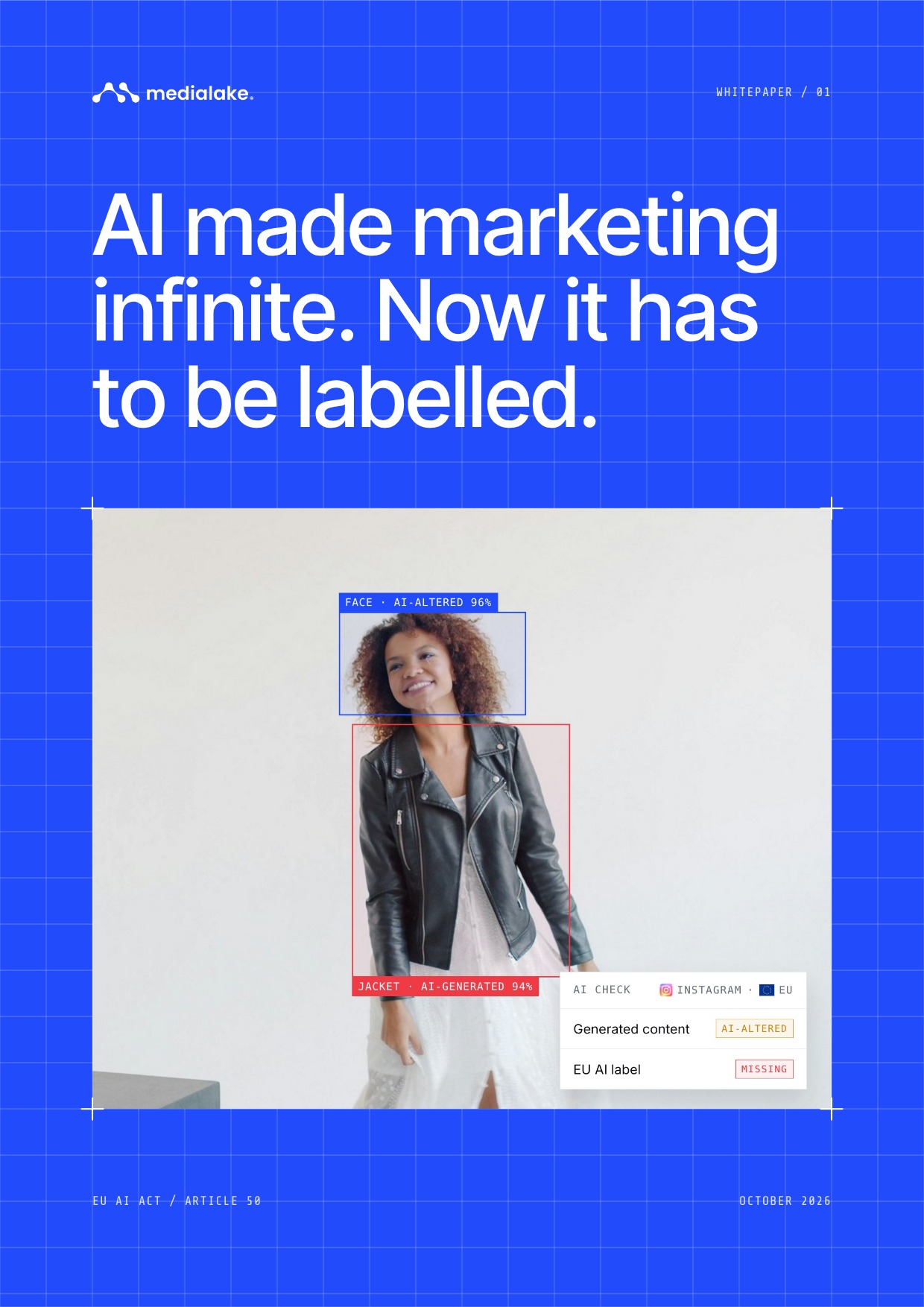
01Every AI-amended asset is now a compliance question
The law is clear. The hard part is knowing where your AI-made content is, and whether its label survived the journey.
Brands have adopted generative AI faster than any production tool before it. Since 2 August 2026, the EU has required them to say so whenever AI-made content could pass as real, and other markets are doing the same. Most brands have a policy. Few can prove it holds, because the label is applied once, to a master file, and then the content travels through agencies, markets, retailers and platforms that strip it away.
- 01 · The shift
- AI is already in most marketing content: the IAB expects 39% of digital video ads to involve generative AI in 2026.
- 02 · The rule
- The EU AI Act requires brands to label AI-made content that could pass as real, with fines of up to €15 million or 3% of turnover.
- 03 · The reach
- China, South Korea, India, Vietnam, California and New York have rules too, and more are coming.
- 04 · The risk
- Every way of getting it wrong has already happened somewhere, from AI puppies to cloned voices, and consumers are watching.
- 05 · The blind spot
- The label falls off as content travels, people cannot spot AI by eye, and nobody has a view of the whole estate.
- 06 · The fix
- Treat labelling as continuous monitoring of live content, not a one-off policy.
02How much of your marketing is already made with AI?
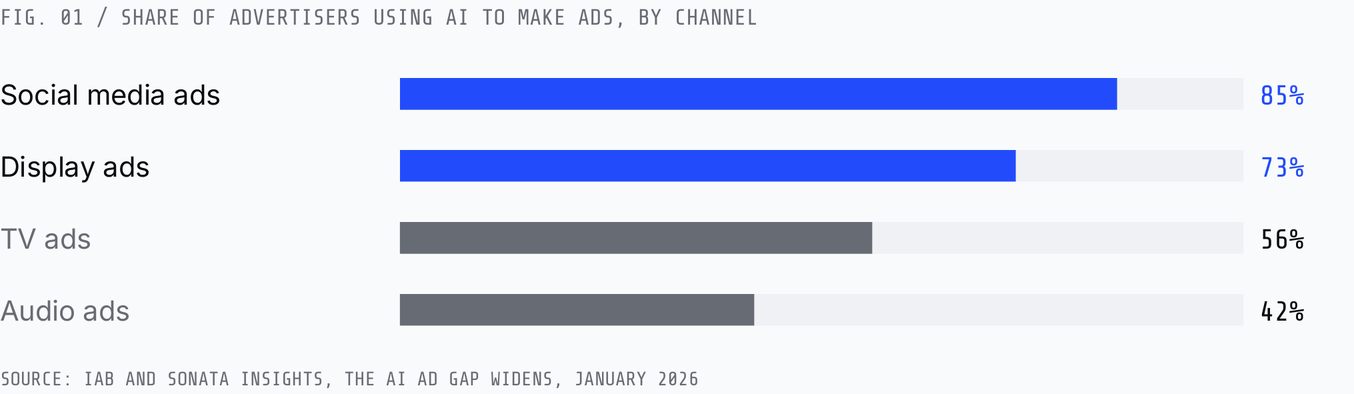
Three years ago, generative AI was an experiment in the innovation team. Today it makes product shots, models, voices and whole campaigns, at a scale no studio could match. That is the opportunity. It is also where the obligation starts.

built or enhanced with generative AI in 2026, up from 30% in 2024 (IAB)
use or plan to use generative AI to make video ads (IAB)
savings on content from AI product twins (Unilever)
| How enterprise brands use it | Example, and when the label applies | Label |
|---|---|---|
| Product imagery | Unilever builds digital twins of its products to make imagery faster and cheaper. AI backgrounds are fine; making the product look better than it is needs a label. | If enhanced |
| Synthetic people | H&M announced digital twins of 30 models. A Guess ad in Vogue used AI models disclosed only in small print, and drew a backlash. | Required |
| AI-made campaigns | Coca-Cola has released AI-generated holiday ads two years running. Realistic scenes need a label; clearly fantastical ones carry a lighter duty. | If realistic |
03What does the EU AI Act require brands to label?
Since 2 August 2026, Article 50 of the EU AI Act requires brands to disclose AI-made content that could pass as real. The duty sits with the brand, wherever the work was made and whoever made it.
- Who · The brand, not the agency
- The duty follows whoever controls the use of AI.
- Where · Anything used in the EU
- Posting on the open internet is enough, wherever you are based.
- Cost · €15M or 3% of turnover
- Whichever is higher, set by national authorities.
or 3% of worldwide turnover, the maximum fine for breaching Article 50
of worldwide annual turnover, if that is higher than €15M
Does it need a label?
Examples from the Commission’s guidelines.
| Content | Label |
|---|---|
| A product shown against an AI-generated background | No label |
| An AI image that makes the product look better than it is | Label |
| A photorealistic model who does not exist | Label |
| An AI-generated actor, digital replica or de-ageing | Label |
| Clearly fantastical or satirical creative work | Lighter label |
| Content generated before 2 August 2026 | Not retroactive |
The label itself
The EU Code of Practice, published in June 2026, offers a common icon and wording such as “AI generated” or “AI modified”. It should sit where people see it first, and be repeated for viewers who join part-way through. Every advertising example in the guidelines needs the standard label.
04When do the AI labelling deadlines apply?
The main duties already apply. The rest land within months.
- 10 June 2026Code of Practice publishedThe EU’s practical route to compliance, with a common label and icon.
- 20 July 2026Final Commission guidelinesAdvertising examples set out: most commercial deep fakes need the standard label.
- 2 August 2026Article 50 appliesBrands must label deep fakes they publish. Fines up to €15M or 3% of turnover.
- 2 December 2026Grace period endsAI tools already on the market before August must mark their output in a machine-readable way.
- 2 February 2027Watermark detectionProviders must make their watermarks detectable across systems.
05Which other countries have AI labelling laws?
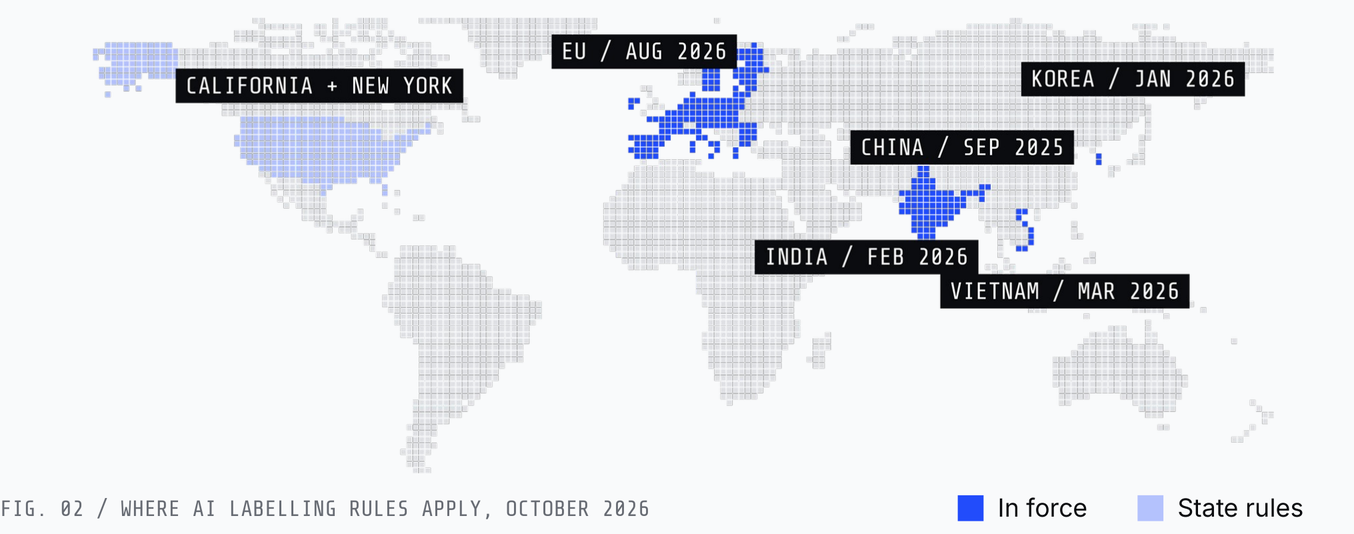
Europe was not first, and will not be last. A single global campaign now meets a different labelling regime in Brussels, Beijing, Seoul, Mumbai, Sacramento and New York. Getting it right in one market is no longer enough.

| Market | Rule | What it means | From | Status |
|---|---|---|---|---|
| EU | AI Act, Article 50 | Label deep fakes; tools mark AI output | Aug 2026 | In force |
| Spain | AI governance bill | National enforcement by AESIA | Pending | Pending |
| Italy | Law 132/2025 | Prison for harmful deepfakes | Oct 2025 | In force |
| Denmark | Bill L 49 | Rights over your own face and voice | Pending | Pending |
| UK | CAP Code, ASA | No AI label duty; ad rules apply | In force | Ad rules only |
| China | Labelling Measures | Visible and embedded labels | Sep 2025 | In force |
| South Korea | AI Basic Act | Label generative output; fines from 2027 | Jan 2026 | In force |
| India | IT Rules amendment | Platform labels and metadata | Feb 2026 | In force |
| Vietnam | Law on AI | Visible and hidden labels | Mar 2026 | In force |
| California | SB 942, AB 853 | AI tools must embed provenance data | Aug 2026 | State rules |
| New York | Synthetic performers | Disclose AI people in ads; up to $5,000 | Jun 2026 | State rules |
Where AI labelling rules apply, October 2026.
06How have brands already been caught out?
Puppies that were not the product. Models who did not exist. Voices cloned without consent. Regulators, courts and consumers have all responded. Each of these has already happened.

- 01 · Making the product look better than it is
- The rule. EU guidelines: an AI image that makes a product look better than reality counts as a deep fake and needs a label. It has already happened. UK ASA, March 2026: a toy ad showed lifelike puppies instead of the product. Ruled misleading, even though AI was involved. What it means for you. AI-enhanced product shots need a label, and must still match the product.
- 02 · Showing people who do not exist
- The rule. EU: photorealistic invented people need a label. New York: ads must disclose AI performers from June 2026. It has already happened. A Guess ad in Vogue disclosed AI models only in small print and drew a backlash. The ASA upheld complaints over an AI-made “Henry”. What it means for you. Every synthetic model or spokesperson needs a clear label, not small print.
- 03 · Cloning real faces and voices
- The rule. Italy can jail harmful deepfakes for up to five years. Denmark plans rights over your own face and voice. It has already happened. US court, July 2025: voice actors’ claims over AI clones of their voices were allowed to proceed (Lehrman v Lovo). What it means for you. Keep consent on file for every face and voice an AI model reproduces.
- 04 · Letting the label fall off
- The rule. EU guidelines expect brands to use contracts so that labels stay visible downstream. It has already happened. Washington Post test: none of eight platforms kept the provenance data on an uploaded AI video. What it means for you. You are judged on where content ends up, not where it started.
Consumers are watching, and want to know
The reputational risk is as real as the legal one.
of consumers want AI-generated content disclosedSource: Meltwater and YouGov, 2026.
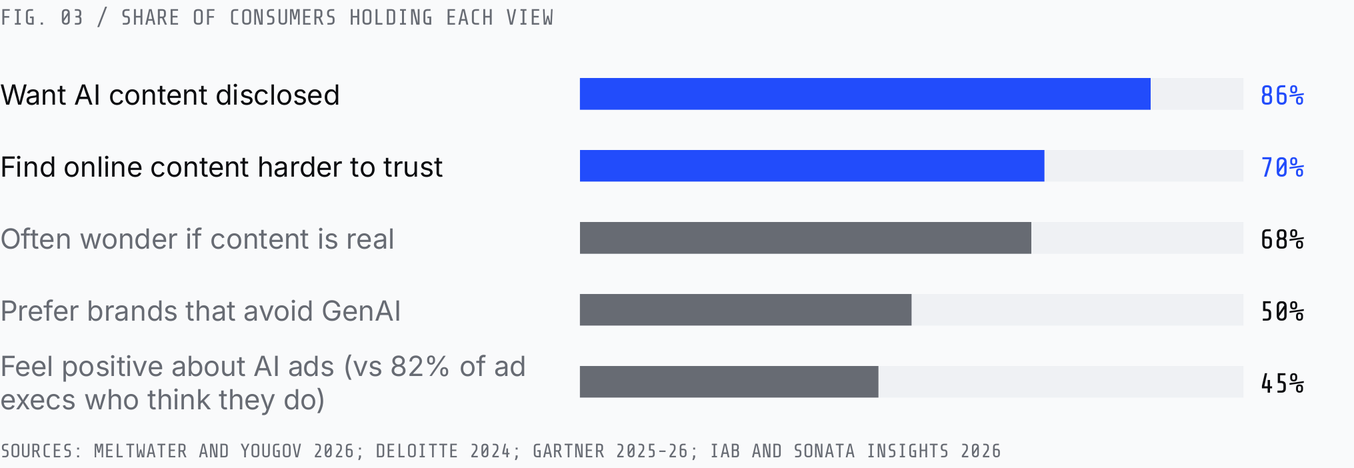
Marketers should treat GenAI as a trust decision as much as a technology decision.
Emily Weiss, Senior Principal Analyst, Gartner, March 2026
07Why do AI labels go missing?
The label is applied once, to the master file. Then the content travels through agencies, markets, retailers and platforms. By the time it reaches a phone, the label is often gone, and no one inside the brand can tell.

| Where the asset goes | What happens to the label | Label |
|---|---|---|
| Master assetMade with AI, approved centrally | Labelled and carrying provenance data from the AI tool. | Intact |
| Agency cut-downs6s, 15s, square, vertical | Re-exporting or converting a file can strip the embedded provenance data. | Metadata dropped |
| Local adaptationsRe-cut, re-voiced, re-texted | A visible label is easily cropped, covered or left off a new version. | Cropped |
| Retailer and partner sitesRe-uploaded by third parties | Partners publish what they receive. The duty still sits with the brand. | Not reapplied |
| Social platformsRe-encoded on upload | In a Washington Post test, none of eight platforms kept it. | Stripped |
Illustrative journey. Figures from the sources shown.
kept the provenance data on an AI video. Source: The Washington Post.
were labelled by five platforms in a 2025 audit. Source: Indicator.
of live outbound content at Fortune 500 brands. Source: Medialake client data.
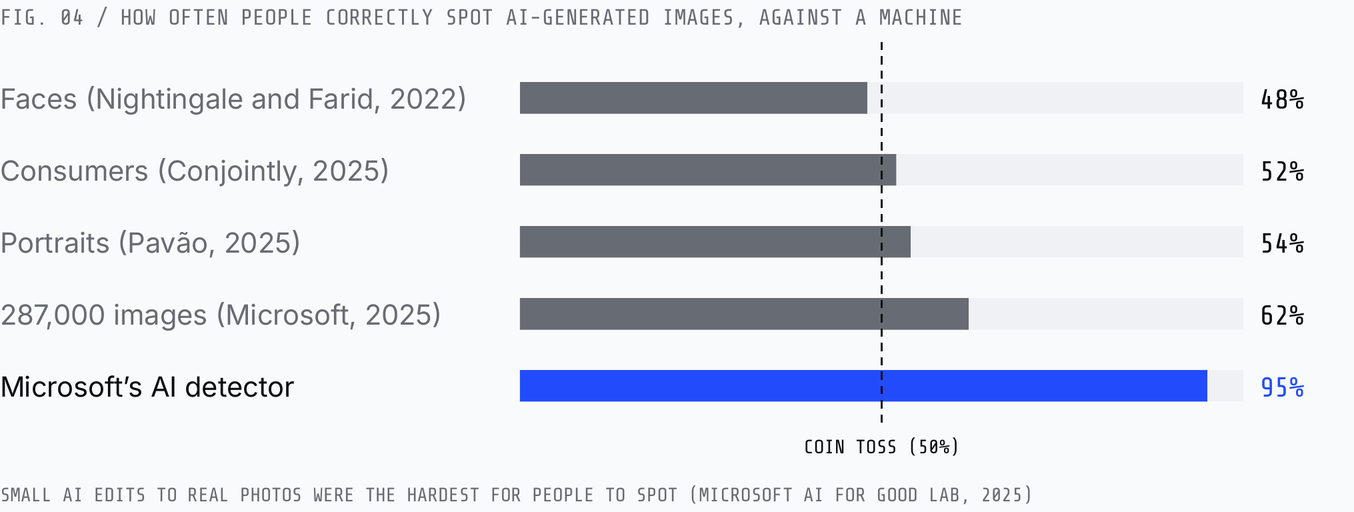
Why nobody notices
People cannot see AI edits, partners have little reason to label, and regulators already use machines.
drop in click-through when an ad is labelled as AI-made, so commercial pressure runs against the label. Source: NYU Stern and Emory.
online ads scanned with AI by the UK ASA in 2025, up from 28 million in 2024. Source: ASA.
What it means for you
Your teams cannot catch AI edits by eye, your partners have little reason to label, and regulators are already looking with machines. Only machine monitoring of the live estate closes the gap.
08How do we make sure our AI content is labelled?
Labelling is not a one-off decision. It is a question to answer for every live asset, in every market, every day.
Policy is the easy part. Proving it holds in every market is the hard part.

- Know where your content runsMap every place your creative is live, including retailer and partner sites, local markets and agency channels. You cannot label what you cannot see.
- Carry the rule down the chainDecide what gets labelled and how, using the EU icon where it applies. Write the duty into agency, production and distribution contracts.
- Monitor and keep the recordCheck live content, not just masters, and keep a record of what was checked and done. Regulators already monitor at scale; brands need to match them.
09How Medialake does it
Find it. Check it. Flag it for review.
Medialake has built workflows and models to show where AI-amended content appears online.
Medialake connects read-only to the DAM, web, social, paid media, CRM, retailer and partner sites, and recognises each asset by what it is, down to every cut-down and local variant.
Purpose-built models flag content that appears to have been generated or altered by AI, including the small edits to real photography that people rarely spot.
Each flagged asset is checked for a label in the right form, in each market and on each placement, not just on the master file.
Flags go to the brand, legal or agency owner for review, with an audit trail of what was checked, when, and what was done.
One read-only layer across the whole estate, with the checks the new rules need.
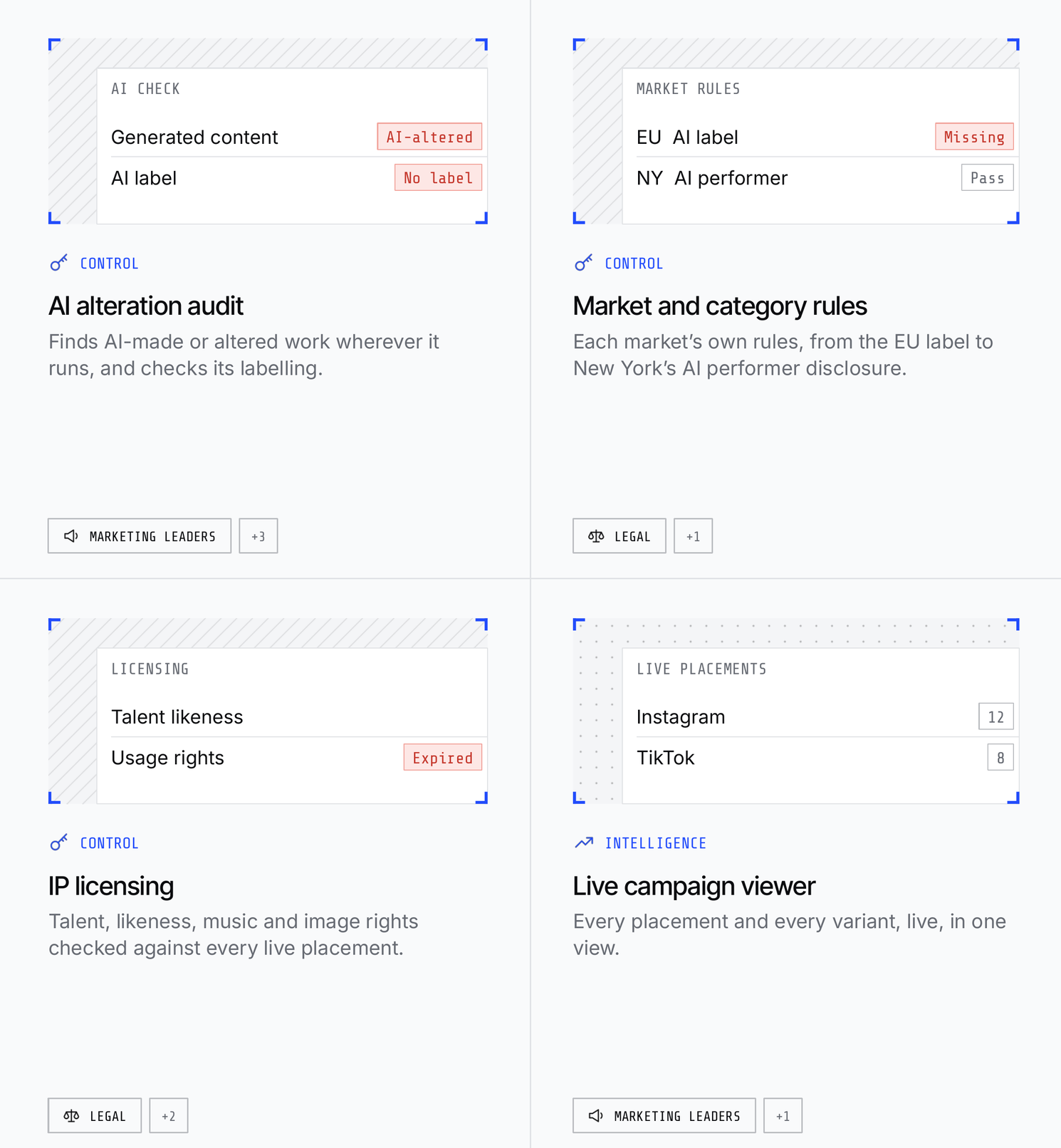
See the AI alteration audit, Market and category rules, IP licensing and Live campaign viewer workflows.
10Frequently asked questions
Does the EU AI Act apply to us if we are not based in the EU?
Yes, for anything used in the EU. Posting on the open internet is enough, wherever you are based.
Is it the brand or the agency that has to label?
The brand. The duty follows whoever controls the use of AI, wherever the work was made and whoever made it. The EU guidelines expect brands to use contracts so that labels stay visible downstream.
Do we have to label content made before 2 August 2026?
No. The rule is not retroactive for content generated before 2 August 2026.
Does the UK have an AI labelling law?
Not a labelling duty. The CAP Code and the ASA’s advertising rules still apply, and the ASA has already ruled against misleading AI ads. A UK brand reaching people in the EU is also in scope of the AI Act.
What should the label look like?
The EU Code of Practice offers a common icon and wording such as “AI generated” or “AI modified”. It should sit where people see it first, and be repeated for viewers who join part-way through.
Get ahead of the label
See where AI-amended content is running across your estate today, and what it would take to govern it.
AI tools already on the market must mark their output in a machine-readable way.
Sources: Regulation (EU) 2024/1689 (AI Act), Articles 50 and 99; European Commission, Guidelines on Article 50 (20 July 2026); Code of Practice on Transparency of AI-Generated Content (10 June 2026); Reed Smith (28 July 2026), Paul, Weiss (August 2026) and Cooley (3 August 2026) on the final guidelines and Code; IAB, 2025 Digital Video Ad Spend and Strategy Report (July 2025); IAB and Sonata Insights, The AI Ad Gap Widens (January 2026); Unilever press release on product twins (March 2025); Business Insider on AI advertising controversies (December 2025); Spain AI governance bill (ECIJA, Reuters); Italy Law 132/2025, Criminal Code Art. 612-quater; Denmark Bill L 49 (October 2026); China AI content labelling measures (September 2025); South Korea AI Basic Act (January 2026); India IT Amendment Rules 2026; Vietnam Law on AI 134/2025/QH15; California SB 942 as amended by AB 853; New York General Business Law s. 396-b; ASA rulings on WiggyDog (March 2026) and Henry’s Boots, via Wiggin and Osborne Clarke; ASA and CAP Annual Report 2025; Lehrman and Sage v Lovo Inc, S.D.N.Y. (10 July 2025); Nightingale and Farid, PNAS (2022); Conjointly (September 2025); Pavão, arXiv (December 2025); Microsoft AI for Good Lab (July 2025); Indicator platform labelling audit (November 2025); The Washington Post platform test (October 2025); Lee, Todri, Adamopoulos and Ghose, NYU Stern and Emory (2025); Meltwater and YouGov (April 2026); Deloitte consumer survey (2024); Gartner consumer surveys (March 2026); Accenture Life Trends 2025; Medialake client data (66.9% of live outbound content sits outside the DAM, measured across Fortune 500 clients).
Published 28 October 2026. This paper is for information only and is not legal advice. Rules and dates are stated as at October 2026. Download the PDF version.